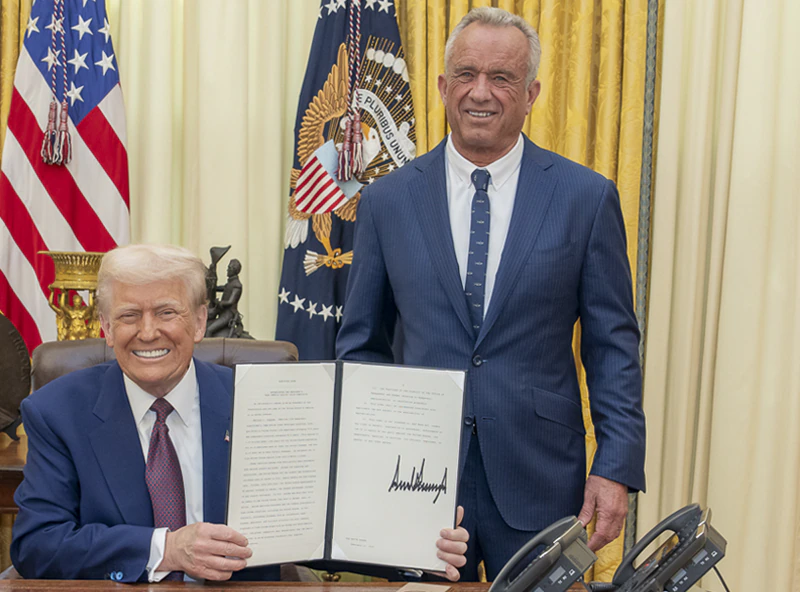
In a political career marked by controversy, President Donald Trump has always been outspoken. His brash, direct, and often offensive personality has been a selling point to voters fed up with the evasiveness and empty promises of “established” politicians. In reality, his temperament has often set him in opposition to established fact.
“Tylenol is not good; I’ll say it, it’s not good,” Trump said in his laconic manner during a recent press conference. The conference was held to announce changes to labels on acetaminophen (a painkiller) and leucovorin (a standard cancer treatment). The new labels warn pregnant women from taking acetaminophen, and they classify leucovorin as a treatment for autism, a disorder affecting speech, communication, and social adjustment that Trump attributes to Tylenol.
There’s no question that cases of autism have increased in the last two decades, 300 percent according to the records of the Johns Hopkins Bloomberg School of Public Health. This increase is concerning, but not for the purported reasons. Awareness of the disability in its myriad forms expands with every study conducted and every child diagnosed, revealing portions of the community that have been misunderstood and improperly served since autism was discovered in 1943.
“Autism is a spectrum,” Jackie Roberson, a local specialist in the development of the disabled, said.
It’s a statement we hear frequently, but she’s seen it play out firsthand. In her 30-year career, Roberson has assisted disabled children from every walk of life, helping them carry out daily tasks and function on their own. Her experience has taught her that two cases are rarely the same, and pigeonholing a group as exhibiting three or four traits does a disservice to everyone.
“One thing I’m so happy to see recently is how much better we’ve gotten at identifying all kinds of autism. Over the years, I’ve seen kids I would never have imagined had any problem at all,” Roberson said.
Many parents of autistic children, if asked, would echo this observation. And as information and treatment become more accessible, many are signing their kids up for care they would never have received. In short, the surge in new cases reflects how few were being recognized before.
In light of this fact, the president’s claims regarding Tylenol and its suspected dangers are both unfounded and hazardous. Millions of mothers have used Tylenol and other drugs during their pregnancies to maintain comfort, medicate pain or manage unrelated bodily issues. Darius Harandi, a student at State High, is the child of one such mother.
“My mom used Tylenol to deal with back pain while she was pregnant with me,” Harandi said. “As you can see, there’s nothing wrong with me. Lying about the drug causing disorders just makes things harder for people trying to have kids.”
But why would Trump make this statement in the first place? Is Trump’s statement one of careless ignorance or intentional dishonesty?
Certainly, the President is no stranger to misstatements. This past August, he promised to cut drug prices by 1500 percent. But the probable reality is more galling. Trump’s autism claims, along with every other harmful untruth his second administration has spread about medicine, are a matter of cutting costs.
It isn’t any secret that the Republican Party thinks the American medical system is too expensive. No further proof of that sentiment is required than the budget resolution it passed this summer, which cut Medicaid spending by some trillion dollars. The reduction, part of a broader effort to lighten federal expenditures, ostensibly to free up capital for several other projects, including erecting a ballroom in place of the storied East Wing and repaying the allies who covertly funded Trump’s campaign.
The dilemma, in this particular case, that Trump and his agenda are up against is the fact that millions of Americans depend on medical programs for survival. In an age where obesity has reached an epidemic pitch, terminal disease has replaced airborne infection as the most deadly form of illness, and neurological disorders—including autism, ironically—are being exposed and treated in full for the first time, coverage for a doctor’s appointment could not be any more vital. The public health system is unpopular—and with good reason. Part of that unpopularity stems from the fact that it gave Americans a shawl when they needed a windbreaker; it wasn’t extensive enough. Trump’s slashes represent the wrong kind of progress.
These circumstances force the president to use the only arrow left in his quiver—fear. Simply put, stoking suspicion of the institutions, professionals and treatment that make medical care important is the best method he has of making Americans avoid it, of getting them to relinquish services they would otherwise hold onto for dear life. The consequence of this strategy goes without saying. More Americans will shun useful medications arbitrarily deemed dangerous. Mothers of neurodivergent kids will fault themselves for a condition out of anyone’s control, one that most experts agree is genetic. Underprivileged families, already struggling to pay rising expenses, will carry an additional financial burden, their tribute to America’s newly elected, self-proclaimed king. Will they tolerate it? Time will tell…