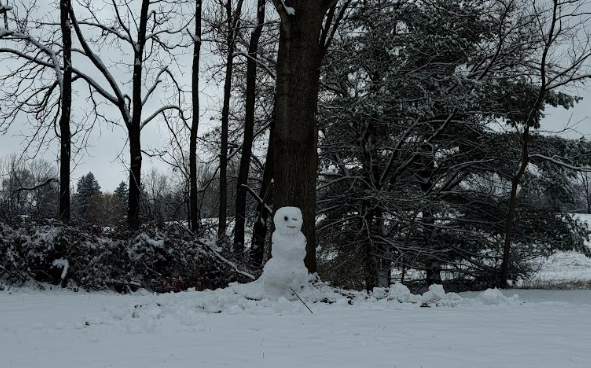
State College has experienced an unusually snowy winter this year, leading to multiple school delays and cancellations that have affected students, teachers and families across the district, including State High.
While snow days are often exciting for students, the recent weather has raised questions about why snowfall has increased and its impact on learning.
The US’s winter weather depends on the shifts in the polar vortex, which is a large region of cold air that surrounds both Earth’s poles: Antarctica and the Arctic Ocean.
When the polar vortex expands, it sends the cold southward with the jet streams, which are relatively narrow bands of strong wind in the upper levels of the atmosphere. These strong winds are created as the freezing polar winds interact with the warm tropical winds and the difference in the pressure levels creates strong currents. A southward dip of these winds can funnel Arctic air deep into mid-latitudes, causing colder temperatures. Thus, due to a disturbed polar vortex, winter has gotten off to a snowy start in the northern United States this year.
Matthew Bardo, a science teacher, further discussed the reasons for the snowy winter in State College.
“We look at three different things. You can have La Niña, you can have El Niño, or it can be neutral. And right now, we’re experiencing a very weak La Niña pattern, which basically means that the sea surface temperatures in the Pacific Ocean are slightly colder than average. So when that happens, sometimes we see an increase in lake effect snow. So a lot of the snowstorms that we’ve gotten have either been lake effect in nature or these small clipper storms that move from west to east,” Bardo said.
According to the National Environmental Satellite, Data, and Information Service, “Lake effect snow forms when cold, below-freezing air passes over a lake’s warmer waters. This causes some lake water to evaporate and warm the air. Then, the moist air moves away from the lake. After cooling, the air dumps its moisture on the ground, potentially becoming snow.”
In addition to the effect of snowy weather on the outside temperatures, it also affects the school schedules.
Snowy weather has caused delays and cancellations of school in these past months, which can cause disruptions to students’ learning because teachers need to shorten their study materials, and students may forget the material they have been studying before because of school closures.
For students, school cancellations and delays are exciting most of the time, because they have more free time to spend with friends, family, or even doing the homework they had to do.
For other students, a two-hour delay might seem perfect as a regular school schedule.
“For the delays, I feel like it’s a lot better to have a two-hour delay every day than a normal schedule, in my opinion, because you sleep more, you’re more awake during class, and you probably have more time to eat breakfast than if you would wake up normally. So I honestly think that having a delay is better,” sophomore Ghala Altemani said.
Melissa MacNeely, an ESL teacher, discussed how schools can stop the education disruptions for students by considering a Flexible Instructional Day, where students and teachers learn online and do asynchronous activities. This way, students could practice skills in order to prevent educational disruptions and not forget the past material.
“There’s lots of arguments to foreign against flexible instruction days, but I just think that’s a way that we as a district could make a compromise so that there isn’t so much learning being lost,” MacNeely said.
As winter continues, experts say snowfall may remain unpredictable. Understanding the science behind the snow helps explain why these conditions are happening, while recognising their impact reminds the community that weather affects more than just the forecast; it affects daily life in State College.