

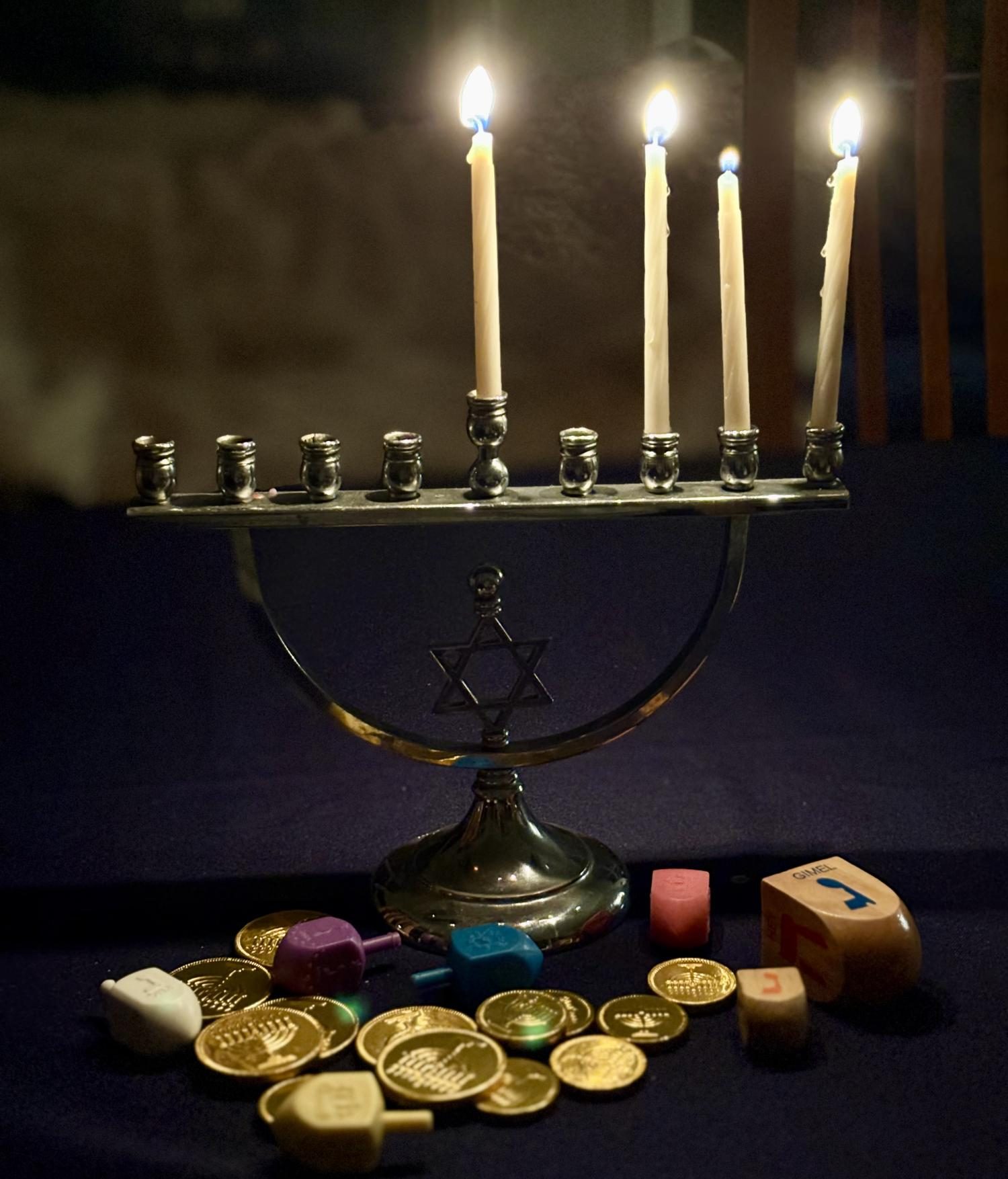
As Jewish students spin dreidels, light menorahs, and gather with their families and friends to celebrate and honor their Hanukkah traditions, they also have to juggle their schoolwork and activities after a full day of classes. Above 98% of public schools have Christmas off, but less than 10% of the same schools have Rosh Hashanah, one of the most important Jewish holidays, off from school, according to BBYO, the B’nai B’rith Youth Organization. This statistic, while inequitable, isn’t unfamiliar to members of the SCASD school district. The most widely talked about instance is the current issue of Hanukkah’s timing in relation to Winter Break.
Hanukkah is a Jewish holiday that lasts for eight days and commemorates two miracles: the Jewish people unexpectedly won a war, and a small amount of oil that was supposed to last for one day lasted eight. Jews commemorate the holiday in various ways, but the most common experiences include lighting the menorah, reciting prayers, retelling the story of the miracles, playing dreidel, and eating traditional foods. Lauren Krentzman, a Jewish senior at State High, participates in all of these traditions and more.
“We always do a night of traditional food for Hanukkah. We’ll do latkes, anything fried, and we have our whole extended family over. So there are ten of us, and it’s a really fun time,” Krentzman said.
She also enjoys having friends over to teach them about the holiday. Evan Zorn, a junior, celebrates similarly. Zorn views the holiday as a day of remembrance and thankfulness, and he engages in “small traditions” for the holiday, including small presents, lighting the menorah, reciting prayers, and most importantly, spending time with family.
Every year, students and teachers at State High get out of school for Winter Break, which is timed to allow students who celebrate Christmas and Kwanzaa to have time off to celebrate. Most years, Hanukkah aligns with the break for several days, but this year, there is no overlap. This raises a question: Do Jewish members of our district deserve a day off from school for their winter holiday as well?
To answer this question, Aaron Moon, the Secondary Equity Liaison for the school district, provides his professional and personal opinion. First, he recognizes the difficulty of assigning breaks to Jewish holidays such as Hanukkah because they are based on a different calendar (the Hebrew Lunisolar calendar) and start at sundown, meaning they change dates annually.
He also acknowledges the calendar committee of teachers who develop the academic calendar before it gets approved by the superintendent, who decides the days students and staff should get off school. Recently, the topic of a future “Hanukkah break” came up at a board meeting where they discussed whether it deserved time off. Moon mentions his personal opinion, which is that, despite the difficulty of Hanukkah’s changing dates, it is important to give people participating in the holiday some time off to celebrate.
“There are so many things that go on behind the scenes, but I know there are a lot of adults and even students who are very passionate about trying to figure out a way for how this can work for each year,” Moon said.
He continues by discussing the role representation plays in these decisions as well. Factors like the number of students who celebrate it and the usage of a “holistic approach,” as he puts it, are both considered when making these decisions.
“I think the real big point is looking into how many families and community members it could affect,” Moon added.
Zorn’s thinking is along the same lines. While he believes the holiday should get some kind of recognition in the calendar and Jewish students should have some time off from school, he also recognizes the very few number of Jewish students there are in the district. Therefore, he states that all eight days would be, while appreciated, unrealistic and unnecessary. Zorn’s solution is to take off the last day of the holiday to allow those celebrating the time to spend with family and friends.
“It is disappointing that we don’t have off for Hanukkah, but it does totally make sense because the holiday is more of a sundown holiday,” Krentzman said when asked about her opinion on the topic. “So it does make sense, while it is disappointing that I can’t take the day off.”
She also acknowledges the progress being made in the recent addition of the Jewish New Year, Yom Kippur, to the academic calendar. This is a recent decision made in late 2022, which gives students a break so Jewish members of the school district can engage in a 24-hour fast without having to attend school. Krentzman views this as a step in the right direction and expresses her gratitude for this day off, viewing it as a more important holiday.
“I definitely view other holidays, like Yom Kippur, as more important to have off, because we’re fasting, and that takes a lot out of you, and it’s just a super religious holiday. So, while it is disappointing, I do understand,” Krentzman said.
In the end, State High staff and students agree that it is important to consider the different traditions groups have and how the school should accommodate them.
“I’m hoping that in the next couple of years that we’re starting to grow, where community members and even students start to add in a little bit more of the ‘why’ we should be off during these times,” Moon said. “And I’m hoping that kind of conversation can happen in order to see how we can support our family and friends who celebrate Hanukkah for those times off.”





Andreas Thorsen • Dec 23, 2025 at 11:20 PM
Nice job getting perspectives of students and an administrator. You really got to the core of the issue. Also just super well-written in general. A talented writer!
Lizzie Parra • Dec 23, 2025 at 9:47 AM
Great article! Well done!