

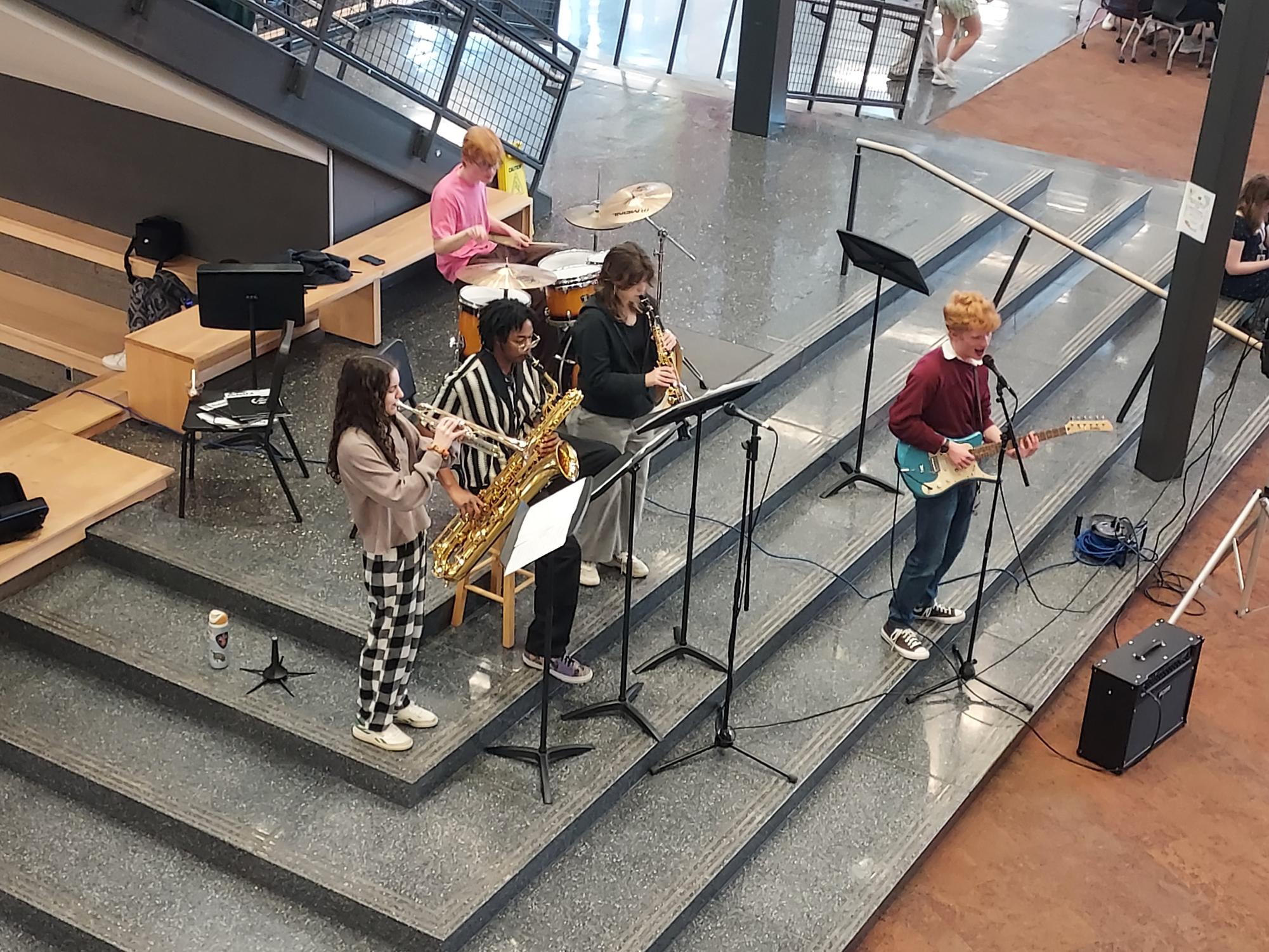
On March 6, State High held its 2026 Spring Mental Health Summit. A bi-annual tradition dating back to 2023, Mental Health Summits take place during a two-hour delay on the last day before an approaching break, offering students a rare opportunity to unwind, explore the school, and interact with their peers in a recreational environment, with the goal of building community and easing academic duress at an important juncture in the year.
The summits represent a fun time when State High’s enormous building and facilities become a leisurely environment. The school theatre plays movies, the main gym hums as band kids and all-state athletes alike gather around for games of pickup basketball, and face-paintings, snacks and camaraderie are visible all around. To kids for whom the break from school means a pile of makeup assignments larger than an ordinary week’s workload, the library offers a quiet place to get out of a time crunch.
All of this is excellent on paper, but the reality has raised certain grievances.
“In my opinion, the Mental Health Summits are kind of unnecessary,” senior Frank Statham said. “Don’t get me wrong, I think all of the activities are fun, but I don’t know why they don’t just give us an actual delay.”
His sentiments are shared by many, and plenty of people do take advantage of the quasi-delay. Others fully object to the summits, or at least find them less than helpful.
“I’m gonna sound a bit nerdy for this, but it sort of gets in the way of school. I have a test on [the day of the summit] and now I have to finish it in like 45 minutes,” Andrew Gregory said.
It’s a problem slightly bigger than the solution of doing homework in a library for two hours while your friends eat ice cream and play cornhole.
Some also take a slight issue with the name of the summits. Advertised under the implication that they improve mental health, they mostly involve games and distractions that, while fun and engaging in the moment, only offer a short reprieve from the whirlwind of assignments, extracurriculars, jobs and college recruitments that fill up high schoolers’ lives. Students leave for the day with temporary tattoos, yet no permanent mechanisms for dealing with the problems that left them craving a dopamine hit in the first place are provided.
“If it’s just a fun day, then call it ‘Fun Day,’” senior Andrew Haag said. “Why pretend it’s anything more?”
Some students don’t even pretend. As previously mentioned, skipping the summits—and sometimes even the school day that follows—is a common practice, especially among upperclassmen, often diminishing the experience for those who do show up.
“Nobody I know came to school today,” senior Aiysha Watson said. “I just drew on my iPad the whole time.” A couple of solo activities were available at the summit, to be sure—Just Dance in the cafeteria, for example—but with so few friends around and only so much to do, it’s not uncommon to walk away with experiences like Watson’s.
“I think the Mental Health Summit has the potential to be a good community-building opportunity,” Watson concluded. “But it could definitely be better organized.”
This isn’t to say that every experience is negative. Hundreds of students spend the summits engaged in activities they enjoy with students they don’t know, and new friendships are formed. The main gym is a particular high point, where rotating games of horse and 3-on-3 serve as an effective ice-breaker for basketball players at every level. In the cafeteria, people mingle enthusiastically over chocolate pudding and huddle in friendly circles at the snack bar.
But is all of that worth it? Is it sensible to shorten the last day before a weeklong break so a couple hundred kids can skip school or hang out with old and new friends?
Yes.
It shouldn’t be news to anyone that high schoolers are busy. But that business takes up more than their time. The numerous pressures and conflicting responsibilities students shoulder have a way of taking up residence in their minds, filling their thoughts with tasks to perform and fires to put out, and making school feel like a site for damage control.
State High places strong emphasis on community and connection. That means giving students the space to form new relationships with no stakes, and bringing an air of levity to a climate mostly associated with performance and worry. Two hours of play won’t cure anyone’s problems on its own–but the need to budget time, to get things done, to make the most of every minute like engineers perfecting a production line, is exactly what destabilizes students’ mental health in the first place.
The experience can be better handled, more practical assistance can be provided, and the title may need reimagining. In principle, though, the Mental Health summit is undeniably a positive part of State High’s culture. So enjoy your pudding. It’s not that deep.



Silas • Mar 18, 2026 at 10:28 AM
This is a really good opinion piece! I have anxiety and I can say from experience that the summits are too loud for me to be able to calm down during them, but I do still have fun.
Elot Matt • Mar 16, 2026 at 11:04 AM
Cool picture