On April 1, 2026, the Supreme Court heard oral arguments in Trump v. Barbara. The case will decide the future for immigrants across America, and if the court rules for Trump, it will harm our country. The Trump administration has attempted to impose a new definition on the 14th Amendment to take away birthright citizenship for children born to undocumented immigrants or immigrants on a temporary visa.
The history of the 14th Amendment dates back to 1868, stating, “All persons born or naturalized in the United States, and subject to the jurisdiction thereof, are citizens of the United States and of the State wherein they reside” (U.S. Const. amend. XIV).
Solicitor General John Sauer, representing the Trump Administration, began the oral arguments. He stated they are not entirely “subject to the jurisdiction thereof,” because of their unlawful or temporary status.
Essentially, because they do not obtain the full extent of American rights, Trump claims that disqualifies them from specific rights, presumably, birthright citizenship for their children.
The respondents, Barbara, Sarah, and Mark, are all seeking permanent residency in the U.S., and have had/are expecting to have children born after Feb. 20, 2025, the cutoff date if the Supreme Court rules for Trump. Cecillia Wang, an advocate from the American Civil Liberties Union, presented the oral argument.
She argues that, due to the 14th Amendment and 8 U.S.C. § 1401(a), people born on U.S. soil are American citizens, despite parental citizenship status. She illustrates that the simplicity of the wording in the 14th Amendment, regarding citizenship, is purposely an attempt to eliminate manipulation of the amendment.
Both arguments implement the case study, United States v. Wong Kim Ark, an American, who was born to Chinese immigrants during the Chinese Exclusion Act. When arriving home from China on a trip, he was detained for entering the U.S. illegally, because his parents were not U.S. citizens when he was born.
The Supreme Court ruled that Ark was a citizen, upholding the 14th Amendment.
The Trump administration exploited the term, domicile, mentioned in the Ark case 20 times. Domicile means the person plans to live in the country permanently. They stated that the reason Ark would be a U.S. citizen is that he and his family had not intended to live anywhere else, unlike the status of someone on a non-permanent visa.
Though Wang quickly counteracted that point by stating that the use of domicile in the Ark case is, “irrelevant,” for Chief Justice Marshall defined “subject to the jurisdiction thereof,” as English Common Law: “[I]f you are born in the dominions of the sovereign, you owe natural allegiance, and those who are present in the dominions of the sovereign owe temporary allegiance for as long as they’re present.”
The attempt to diminish the 14th Amendment is a petty way to strip away Americans’ rights due to preexisting prejudice. Thankfully, there are people like Wang and the respondents who are willing to step up for justice in America.
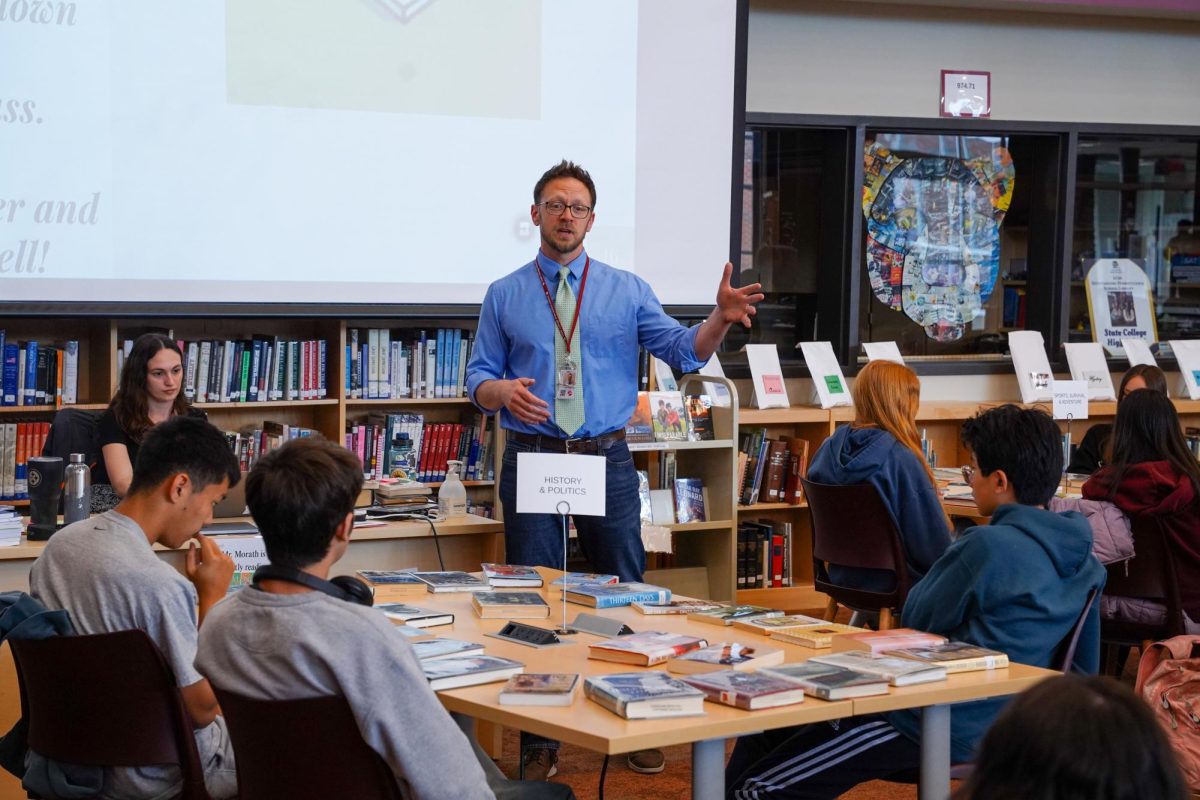
A State High senior and activist in the community, Sarah Ocampo, shared her input about the case. “The fact that it was even proposed in the first place is just absurd, for lack of better words… The question of whether someone is entitled to a constitutional right, based on anything in terms of immigration status, a supposed immigration status, skin color, the language that you speak, or the culture that you’re from, is abhorrent. And I think that it should be criticized as such,” she said.
She explains how change begins from the ground up. Knowing what decisions are being made at the top and how it affects our community is crucial to understanding how students can speak up and make a positive change on the local, state, or national level.
She went on to explain how the government has come to this, and what people need/have begun to recognize what our government has been doing.
“We let that behavior reside in the first place, and it only accumulates, it snowballs into more, and I think that as a reflection of the United States, it just remarks on what we need to do better, and I hope that people now, seeing how severe misogyny and racism are, especially, we can work to correct it,” Ocampo said.
Because it’s the newborn child who would be in the country illegally, while the parents may still have a visa, the baby would be eligible for deportation. Trump has said he has no intention of breaking up families, yet in a 2024 interview with Meet the Press, his proposed plan to keep them together is problematic: “So, the only way you don’t break up the family is you keep them together, and you have to send them all back.” (Meet the Press 24).
This would affect the nation, as many as 225,000 to 300,000 babies are born each year to an undocumented mother. Not only would the baby be deported, but the whole family too, resulting in mass deportations.
This affects the economy because, although undocumented immigrants only make up 5% of the workforce, they contribute significantly to industries such as 14-20% of construction, 12-45% agriculture, and 7-12% of hospitality; if people were deported for having children, unpopular jobs would lose many employees, resulting in problems down the road.
Even if this weren’t the case, the mass deportations of infants and their families cause humanitarian and personal harm to families, while simultaneously feeding into racist and misogynistic laws.
Also, countries that are given children born in the United States may not recognize them as citizens in the parents’ origin country, either, rendering them stateless.
What the Trump Administration is proposing, and what actions they have taken against minorities, immigrants, the working class, and women, are despicable. Attempting to take away birthright citizenship demonstrates racist and prejudiced motives in the White House, for it denatures the meaning of the 14th Amendment, and creates the notion of us versus them, a harmful narrative for a diverse country.
The United States of America is unique, for there is no national language, no national religion, no one way of living. It was set up and promoted as a place for the dreamers, the ones with ambitions to attempt the old American dream. What makes one an American is one who dares to fight for their passions and believes they can succeed.
That is why thousands come to the United States: to have access to something they didn’t have in their country of origin. So denying one a chance, even when on a validated visa, because they got pregnant, is frankly, un-American, plus violates the constitution, as argued by Wang.
The bad behavior that has been allowed to accumulate within the White House, even before Trump’s first and second terms, has already poisoned our nation. As residents in the United States, it is our responsibility to hold our government accountable, to make sure they are working for us, not the other way around.
America was born through a shared dispute of determination. That is what founded our nation, and that’s what we need to keep it going.