Since May 17, 2004, transgender athletes have been allowed to compete in the Olympics based on their reassigned gender to a certain extent. The original policy stated that female-to-male and male-to-female athletes who have had a minimum of two years of hormone therapy and whose gender reassignment has been legally recognized may compete.
But on March 26, 2026, a new policy was announced, introducing a new test to determine the eligibility to compete in female category events (whether team or individual sports). The test looks for the presence of the SRY gene, which, according to the IOC, means that an athlete has experienced male sex development.
Later that day, the International Olympic Committee YouTube channel posted a video from the IOC President Kristy Coventry, who vaguely explained the point of the policy.
“As a former athlete, I passionately believe in the rights of all Olympians to take part in competition. The policy that we have announced is based on science, and it has been led by medical experts with the best interest of athletes at its heart,” she said in the video.
But she directly contradicts the policy’s claim. How can all Olympians take part in the competition if some are excluded?
Additionally, why not create a category for transgender women instead of excluding them? And why is there no mention of transgender men if they are also biologically female?
What this policy is doing is creating more fear and stigma around transgender people. The space that LGBTQ+ activists have strived for decades to create has been abruptly closed.
Furthermore, this policy was deliberately announced after the 2026 Olympics had ended, in order to decrease controversies. And it worked. Many people I spoke to had no idea that this had happened.
“I just think that they’re trying to make trans people, just existing and [following] their dream, seem like a threat,” junior Asher Freese said.
State High has always been an inclusive community. Offering a variety of sports and clubs, many students feel safe here. But when policies like these become international, they create a chain reaction.
Furthermore, Coventry stated that the “policy is based on science,” and while there may be newer research that proves that transgender women have an advantage, there are no links to any additional studies that may have been produced or names of scientists and medical professionals who worked on the policy.
According to a 2024 study funded by the IOC and published in the British Journal of Sports Medicine, transgender women have multiple disadvantages compared to cisgender women.
All of the women involved in the study were athletes: the 23 transgender women were ages 10 to 34 years, and the 21 cisgender women were ages nine to 30 years.
One common misconception is that transgender women have higher endurance than cisgender women. Yet, in both the lower body strength tests and lung function tests, transgender women did not perform as well as cisgender women. This means that in endurance sports such as running, cycling, and swimming, cisgender women have a general advantage over transgender women.
Also, the study proves that the bone density, which is linked to muscle strength, in transgender women and cisgender women is equal. There was also no big difference in hemoglobin levels, which is key in athletic performance.
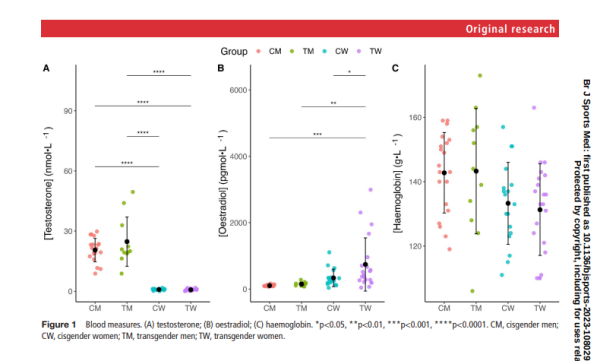
In the end, the study concludes by cautioning against “precautionary bans and sport eligibility exclusions.”
So what is this policy actually trying to achieve?
“It feels unnecessarily targeted and unfair because there are natural fluctuation levels of hormones within cis women as well, and it’s not like there aren’t other factors that affect people’s performance ability; that’s why they’re at the Olympics,” LGBTQ+ Alliance Club officer Tayler Maggs said. “Obviously, you don’t want to make competition unfair. But you can take a look at the thousands of cis athletes who have participated in the Olympic Games, like Michael Phelps. The way his joints line up make him biologically better at swimming than a lot of other athletes.”
It’s also important to know that the Olympics and other global competitions have had a history of discrimination against women.
In 2009, Caster Semenya, a South African cisgender woman and middle-distance runner, was asked to undergo sex verification tests after her victory at the World Athletics Championship that year. Later, in 2019, she was asked to take medicine to suppress her testosterone levels. And only a year later, in the 2020 Olympics, Semenya and other distance runners: Christine Mboma, Beatrice Masilingi, Aminatou Seyni, Margaret Wambui, and Francine Niyonsaba were all withdrawn from their events due to their naturally occurring testosterone levels.
In 2014, sprinter Dutee Chand was excluded from the Indian Olympic team due to accusations against her gender and appearance.
More recently, Imane Khelif, a cisgender Algerian professional boxer who participated in the 2024 Summer Olympics, was accused of being transgender by fellow Italian boxer Angela Carini after a match.
Notably, only one openly transgender woman has ever competed in the Olympics, which was New Zealand weightlifter Laurel Hubbard, who competed in the 2020 Olympics and did not place.
And while this policy claims to decrease safety risks towards women athletes, it may add to risks. The tests come with the invasion of privacy that athletes deserve to have, no matter what. This policy makes it so that the entire world becomes entitled to knowing the biological sex of athletes.
“No matter the decisions of the IOC, and no matter how they’re criticized, globally they set a precedent that definitely gets taken into account when people consider other professional competitions…and even just recreational, like school sports,” Maggs said.
Additionally, it doesn’t protect against sexual assault and abuse, which is one of the largest safety issues in the athletic industry.
According to the Tackling Violence Against Women and Girls in Sport handbook, which was developed by the UN Women, UNESCO, and Global Spotlight Initiative, 21% of global women and girls have experienced sexual abuse in sports, 31.8% of female athletes experience excessive training as punishment, and 10.6% suffer physical beatings. Overall, many athletes suffer mistreatment from coaches, peers, and spectators at events.
Significantly, during Coventry’s time as President of the IOC, she has not made any policies protecting women from sexual assault.
Furthermore, this policy will impact transgender athletes across the world who may have the dream to compete in the Olympics.
In a statement issued to Lions’ Digest by Centre LGBT+, the impact on local LGBTQ youth was brought up.
“Policies that categorically exclude transgender individuals—particularly transgender women—from participation in sports raise serious concerns about equity, dignity, and belonging. For many transgender youth, sports are not only about competition, but about community, confidence, and well-being. Restrictions like these risk sending a message that transgender individuals are not fully accepted in spaces where they should feel supported and valued.”
The fight for transgender athletes in the United States has significantly increased since multiple states have banned transgender athletes from competing in school sports. But this policy differs because it is an international ban. And now that it is at the international forefront, this brings into question what other rights will be impacted next.