Students at State High are going beyond reading about science in textbooks; they are making new discoveries that broaden the understanding of the world.
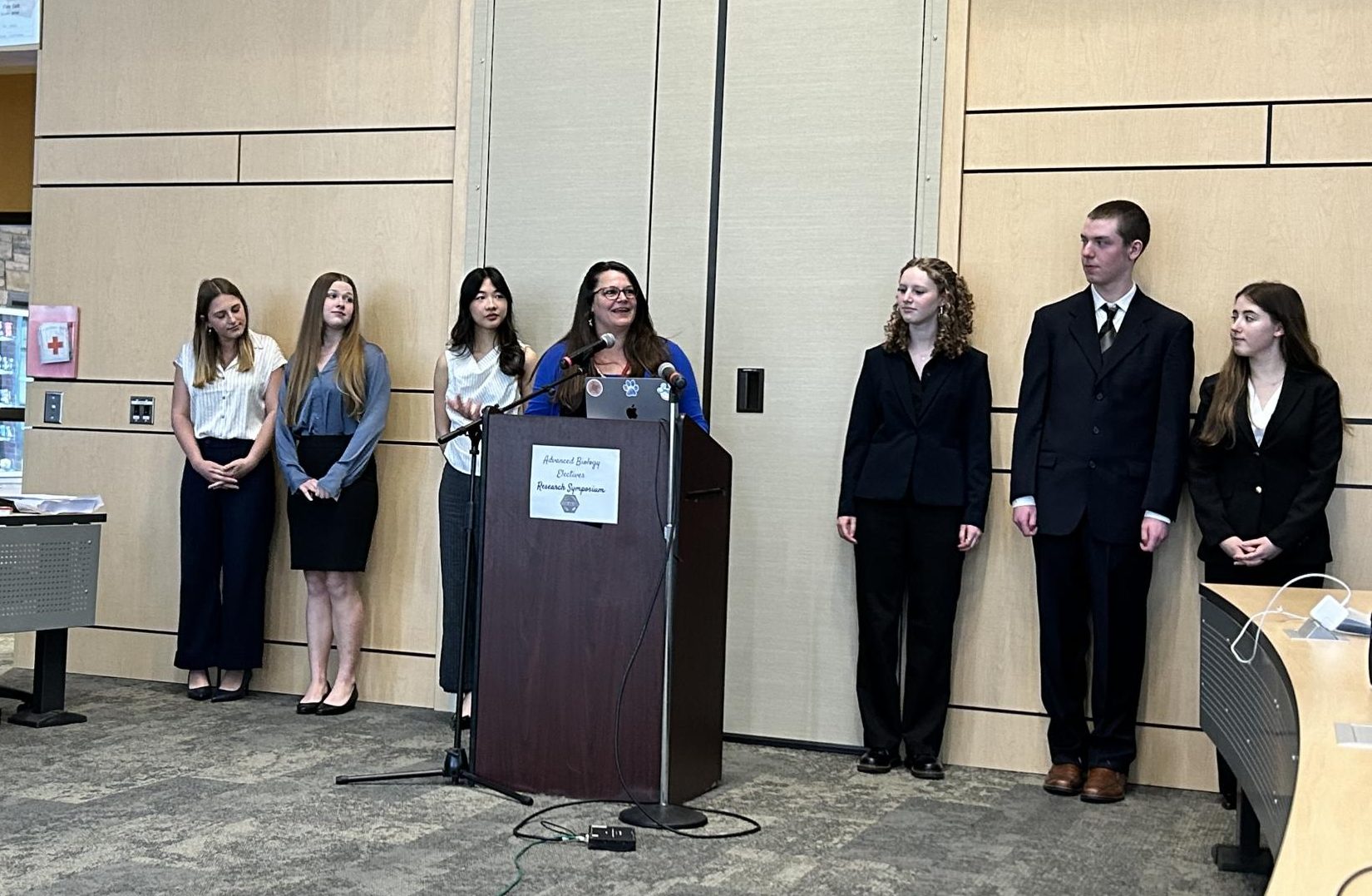
On April 22, students presented research projects to their peers and families at the 5th Annual Advanced Biology Electives (ABE) Research Symposium. Led by Danielle Rosensteel, a science teacher at State High, ABE offers students the opportunity to pursue research projects of their own creation.
ABE began in 2016 and selects the best possible candidates for conducting independent research projects. In some of the research projects, students partner with scientists at Pennsylvania State University and are included on the scientists’ grants.
“ABE teaches students how to work through a project from beginning to end and see all the challenges that go into working in a real undergraduate and graduate level lab, where they’re still in a setting where it’s still safe to fail, and it’s okay for them to fail. So they learn how to fail and how to come back from that,” Rosensteel said.
Zoë Salter
Zoë Salter is one of the senior researchers, and her project focused on the revitalization of the Aquaponics Greenhouse. Before Salter took action, the Aquaponics Greenhouse at State High was unused for four years and in major need of repair. Salter’s project has given opportunities to students for further education and research projects.
“I think my project was important because I think the Aquaponics Greenhouse is an incredibly valuable table that we have, and I feel like what all of us did with the greenhouse is hopefully going to allow us to start to be able to use it again, because it’s such a cool thing that we just have in the building,” Salter said.
Salter plans to continue her passion for biology at Bates College.
Ainsley Martin
Senior Ainsley Martin became interested in biology when she enrolled in Rosensteel’s genetics class. With a particular interest in neuroscience, Martin researched the triggers of epilepsy using fruit flies.
“[I used] a special type of fly that would have seizures if I added extra triggers,” Martin said. “I would either vortex them, or I would expose them to flashing lights, or sounds.”
About 50 million people suffer from epilepsy worldwide. 70 percent of them could live seizure-free if they are properly diagnosed and treated. Martin’s research contributes to a better understanding of epilepsy and possible improvements in the lives of those affected with it.
After high school, Martin plans on attending the University of Pittsburgh for neuroscience on the premedical track.
Melinda Wu
Senior Melina Wu studied the effects of freeze-dried symbiotic Lactobacillus rhamnosus GG, a type of bacteria, on the human gut microbiome.
“I wanted to measure the effect of probiotics on the gut. I had to look into model organisms and what kinds of animals were available to do research on….[I] made procedures and we went through a lot of trial and error, but now we’re here,” Wu said.
Wu added the bacteria to the diet of fish and will then dissect them to understand the effects of the bacteria.
Her project is relevant to recent research as new studies suggest the gut microbiome contributes to a higher risk of certain diseases.
Wu will continue her love for chemical and biological engineering at Princeton University.
Reed Petnick
Senior Reed Petnick explored how to filter microplastics through sand. He found that about eight inches of sand is needed to fully filter microplastics.
“I created a number of filter setups with various conditions, and I…tested how the microplastics came through each one. I then crafted the relationship between depth of the filter and how [the microplastics] came through,” Petnick said.
According to Stanford Medicine, there are an estimated 10 to 40 million metric tons of microplastics released into the environment every year. Petnick’s research contributed to the understanding of how to filter microplastics out of the environment and correct this issue.
Petnick has committed to Penn State for biology and hopes to teach biology to students.
Samantha Warren
Senior Samantha Warren completed biology in ninth grade and wanted to continue learning, so she joined the ABE her sophomore year. Warren’s research project examined the effects of temperature on bacterial colonies.
She partnered with Estelle Couradeau, an assistant professor at Pennsylvania State University in the Huck Institutes of the Life Sciences. Throughout the project, Warren had to deduce the best ways to create this experiment in the high school setting.
“It’s important to work through these failures and… I think it’s important to kind of learn and then be able to do future research and know how to move forward with our research process,” Warren said.
Warren will be attending Penn State for biological chemistry and molecular biology. She hopes to work in veterinary medicine.
Nora Gardner
Senior Nora Gardner investigated the effects of the coloration on Molly fish when they consume microplastics. With the rise in climate change, there have been many changes to the Molly fish’s environment, resulting in the fish experiencing new conditions.
“Being able to read research papers and see what’s worked out for other people and professionals in the field allowed me to get an idea of what I’d be able to accomplish in our timeline and with the budget that we had,” Gardner said.
Gardner will continue her passion for marine biology and education at the Hawaii Pacific University.
All six graduating ABE students are heading to prestigious universities to study science. This year’s ABE Symposium highlighted how ABE allows students with a passion for science to make the discoveries that shape the future.