
Over the course of Trump’s second presidency, Immigration and Customs Enforcement (ICE) has increasingly inserted itself across America, even in State College, PA. Two State College residents were detained in March, and along with the Trump Administration’s attempts to eliminate birthright citizenship for undocumented immigrants, students at State High are noticing changes.
State High has adapted to the changing political policies. Mellisa MacNeeley, an English Language Development (ELD) teacher at State High, described some of the disturbances to American life if the Court were to rule for the Trump Administration in Trump v. Barbara.
“[Students] might have younger siblings, you know, once a family establishes themselves in a community, you might have younger siblings who are born. So it potentially could mean a disruption of their family life,” MacNeeley said.
She continued by sharing ways staff have adapted to changing policy and national events affecting State College to maximize student safety.
“So as soon as the whole thing with ICE came around, we sat kids down, we had some pretty pointed conversations about what it could look like, what you should do, what you shouldn’t do, because we wanted to let them know as school employees, we are in their corner,” MacNeeley said.
She explained specific ways in which State High staff have created safe environments for students to express their beliefs without judgment, such as social studies classes having questions of the day, providing an opportunity to express and validate their opinions, providing empathy, and giving kids confidence.
Due to an increase in aggressive ICE activity, State High’s bilingual liaison, Alix Croswell, described the protocols in place if someone were ever to look for a specific student.
“We would need to be able to engage with the official at the door, but at the same time, ask them to hold on just a moment because the protocol that we have in place requires that we move up the chain of the command quickly to be able to get into contact ultimately with the superintendent and with our district’s solicitor [the school district’s lawyer],” Croswell said.
She explains that an officer would need various types of paperwork, signed by a judge, and permission from legal guardians to be escorted out of school. School staff cannot give out student information due to 34 CFR Part 99—Family Educational Rights and Privacy (FERPA).
Croswell emphasized the importance of the school district’s protective role in the community.
“As a school district, we’re a living organism in the sense that we have to live in the current times and respond to the times and the current events,” Croswell said. “And so when some new issue arises, then all of a sudden we say, ‘okay, we need to put that into action.’”
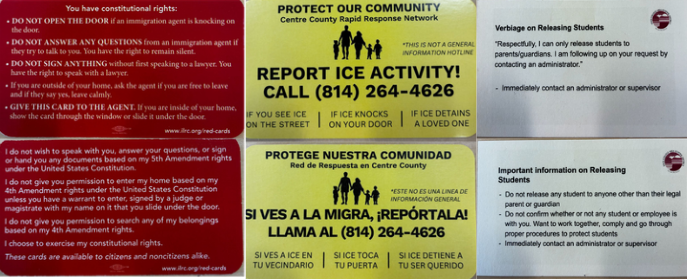
State High is prepared to respond to immigration services if they come to the school. Three different cards are given out to students, staff, and students’ families, providing information on how to respond to immigration services, resources available to them, and their inalienable rights. These are located in the main counseling office.
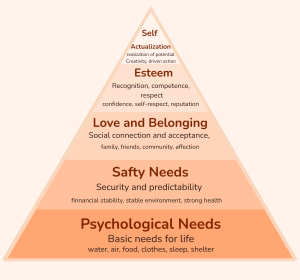
Croswell emphasized the importance of feeling safe at school with Maslow’s hierarchy of needs.
“People need satisfaction for food, hunger, housing, and warmth, protection like that. And then that all wraps up together to create a sense of safety (the base of the pyramid). And all of that has to be in place for individuals, human beings, to be able to engage in higher-level thinking and interaction,” she said.
“If you don’t have the base… if you don’t feel safe at school, you’re in a state of fight or flight. And according to developmental theorists and educational psychologists, the top of the pyramid [academics], you can’t reach those levels of self-actualization. You can’t engage in abstract thought,” Croswell continued.
Faculty and staff at State High strive to make everyone feel safe and ready to learn, and their efforts have intensified in response to the current administration’s impact. Student life has shifted slightly, whether that be an increase in discussions, protocol, or fear.
Those looking for more information on ICE encounters can visit the Centre County Rapid Response Network or the counseling office for information on how to react.