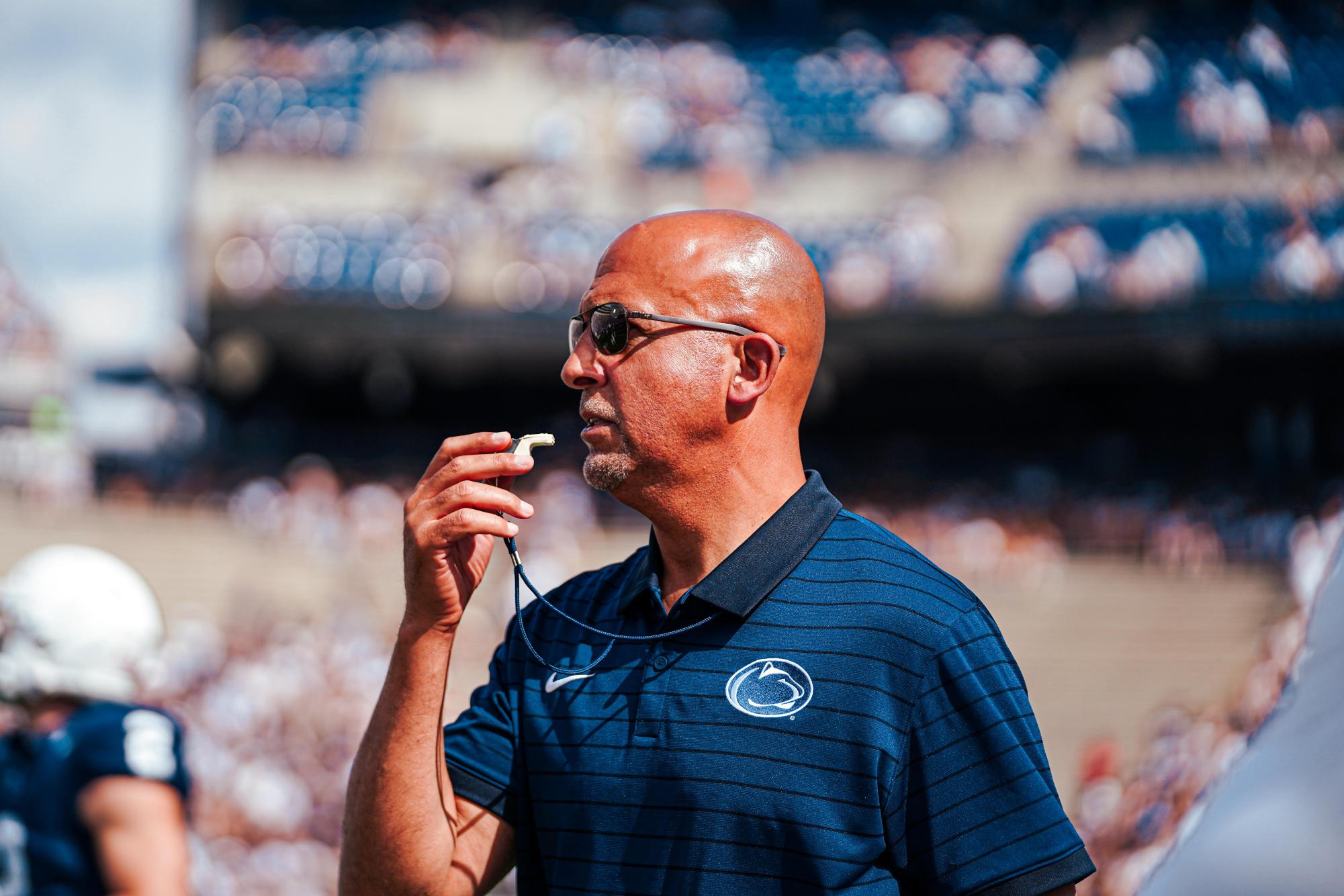
An era for Penn State Football has finally come to an end with the firing of head coach James Franklin following three consecutive losses to Oregon, UCLA and Northwestern. Though some continue to argue that the closing of this chapter was too abrupt, the statistics tell a different story.
James Franklin was appointed head coach of the Nittany Lions in January 2014, and through his 12-year tenure with the program, the trophy case has left much to be desired. Franklin brought Happy Valley only one playoff berth and a singular Big Ten Championship, which many argue to be the only bright spot of his career.
“I think his best win had to be the 2016 Ohio State game, which we thought was going to put us on the map, but it didn’t,” sophomore Crosby Myers, who was one of the many season ticket holders hoping to see Penn State make a deep run, said.
One consistent detail that was brought up a multitude of times before Franklin’s firing was his inability to win big games, and an overall 4-21 record vs AP Top 10 opponents verifies these claims. In this year’s annual White-Out Game for Penn State, the team sat at third in the country, with Oregon just three spots behind in sixth. A game that many thought would solidify Penn State’s title hopes resulted in a double overtime heartbreaking loss that would spiral into the upcoming games.
“You have on paper, the best team in all of college football, you have the O[ffensive] Line, you have the running backs, you have the quarterback, you have the wide receivers now, and you have a top 5 defense. And you still somehow lose to Oregon in a whiteout game,” sophomore Penn State fan Daeshon Hardison said.
A major problem in that Oregon game was quarterback Drew Allar throwing the game-sealing interception on the first play of double overtime. Many fans have critiqued Franklin for his lack of quarterback development, as many past transfers from Penn State have flourished at their new programs, such as Will Levis, Beau Pribula and Ta’Quan Roberson.
Following the Oregon loss, Penn State had back-to-back “reset” games that would help steer them back in the right direction. Except the complete opposite happened. In two must-win games, Penn State’s offense was a no-show, and its defense was even worse. Penn State took on 0-4 UCLA and proceeded to give up 27 in the first half and 42 total within the game.
“I take responsibility for this loss…and I didn’t get it done,” Franklin said in his post-game press conference.
As a head coach of a powerhouse, and following back-to-back losses after a must-win, this is what you expect out of every single coach. It’s one thing not to be able to win the big games, but it’s another to drop a loss to, at the time, one of the worst teams in college football. Following this road loss, Penn State returned home to take on Northwestern, which finished 16th in the BIG 10 last year. The results were a 22-21 home loss, and Happy Valley echoed with chants of “Fire Franklin,” who once again took the blame.
“We shouldn’t lose that game, it’s 100 percent on me,” Franklin said during his opening statement following the loss.
Though Franklin took initiative once again, the damage was already done. He had lost not only the locker room but any potential support from the fans. This led many to wonder how many times Franklin can get away with these detrimental losses and not be penalized for them.
“It was completely unacceptable to lose to Northwestern, UCLA, and the home loss to Oregon; we can’t win the big games. If you can’t win the big games, you deserve to be fired,” Myers said.
Penn State athletics were definitely in the hot seat. The following day, many in the afternoon received a notification from ESPN, which read, “Penn State fires head coach James Franklin after 12 seasons.”
“He built us through the thick and thin, but now we’re in the thin of it…He went 4-21 against top 15 opponents and 1 and 15 versus top 10 opponents. That should never happen with a coach who is in the BIG 10. As a team that is always top 10, but no longer because of him[Franklin]. Embarrassing,” Hardison said.
A shockwave was sent through college sports, but what had happened was necessary. Being a head coach is a tough job with constant expectations, especially if you’re coaching Penn State, but with all the hate throughout social media, the locker room, and reverberating through Beaver Stadium, it had to be done.
From failure to win big games, late-season collapses, poor offensive development, personal and coaching staff issues, expectations with no results, and losing the program’s identity of what it means to play Penn State football, the cons heavily outweigh the pros. With college football changing rapidly, if you can’t keep up with the new powerhouses arriving every day, such as Indiana, there is no spot for you in this league.
Though Happy Valley will not see Beaver Stadium light up for the playoffs this year, a reset might be what the team needed for a chance to chase a National Championship.
Read Max Radio’s take on the issue here.