Imagine standing on stage, surrounded by high schoolers from across the country, each one illuminated by gleaming lights; each one hoping for first place in one of the most prestigious science competitions in the nation. Imagine hearing your name called.
This became reality for one high school student on March 10.
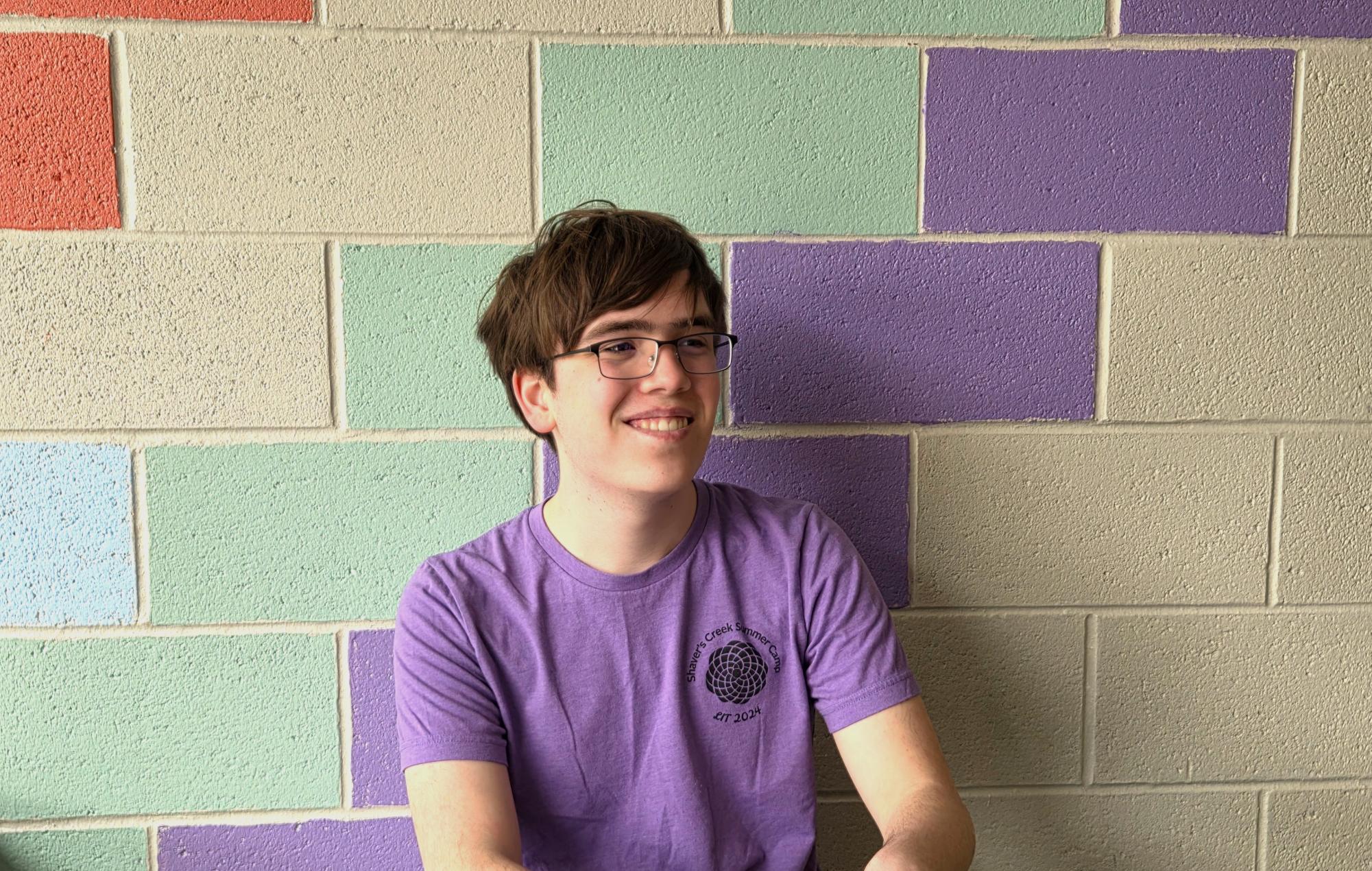
When Delta High senior Connor Hill entered the Regeneron Science Talent Search, he never expected to win first place, let alone $250,000. In fact, he almost didn’t apply.
The competition, held by the Society of Science, works to support the next generation of scientists, giving them the chance to be awarded scholarships and meet with the most prominent scientists in the United States. Many of the alumni have gone on to win respected awards, such as the MacArthur Fellowships or the Nobel Prize, such as the late physicist and Brown University professor, Leon Cooper.
After visiting a family friend in Pittsburgh, Hill was persuaded to apply to the competition. Treating it like just another college application, he never expected to become one of the forty final contestants out of almost 2,600 applicants.
“I wasn’t expecting anything to come out of it, and so, this has become a really big surprise,” Hill said.
But for those close to him, they would already know that his project was special. Over a three-year process, Hill had independently coded a computer program and proof that would make a massive step in advancing the discovery of noble polyhedra. But it wasn’t an easy process.
“There was sort lot of times where I just felt stuck at a certain point and didn’t know where to go…I actually…rewrote my entire code base,” Hill said.
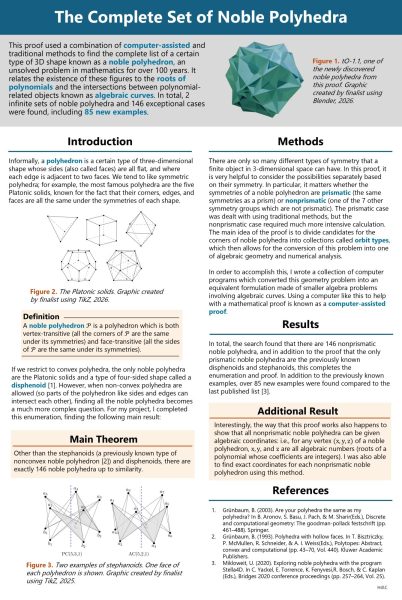
However, Hill kept working, eventually becoming one of only two other mathematicians from the 21st century to have been recorded as discovering polyhedra, and in his case, discovering that there are 146 noble polyhedra.
A polyhedron is a three-dimensional shape, such as a cube. Noble polyhedra differ in multiple ways: being vertex-transitive, meaning every corner is the same under its symmetries; and face-transitive, meaning all the sides are the same under its symmetries.
“[Polyhedra] look pretty complicated. And in a sense, I sort of don’t even know what they look like, because it’s sort of the computer that discovered them,” Hill explained.
“It took me some time to sort of just process…what was actually going on. But I think one thing that really made me stand out is how I did a lot of things independently,” Hill said.
His success may have shocked many students, but it was not a surprise to some. Hill has thrived at Delta since fifth grade, when Delta was still a program. He not only runs Delta’s weekly broadcast, but he also tutors other students. Additionally, he’s a teacher’s assistant for Delta High math teacher Matt Seeland’s AP Calculus class.
“So I taught Connor first as a sixth grader; he was in my Algebra 1 class, and at that time, he asked me so many questions about so many advanced math topics, some of them probably at the college level,” Seeland said. “[Hill] showed me his work, I was able to write a letter of recommendation for him, but it’s all Connor…I was just kind of an innocent bystander along the way, and that…makes me happy.”
Moving forward, Hill already has plans for the future.
“I’m gonna go to college somewhere, I haven’t fully decided yet. Right now, the two I’m really considering are either Penn State or MIT,” Hill said.
Ultimately, no matter where he goes, those at Delta will be cheering him on. Principal of Delta High and Delta Middle, Jon Downs, had some words to say on the subject.
“I’m excited for Connor, not just because of the hard worker he is, but he’s just such a good person, such a great young man. He’s helped out at Delta in a variety of ways…And we’ve had Connor since fifth grade, so we no longer take students in fifth grade. I’ve known him a long time, and just to see his growth–he’s always been a smart young man,” Downs said.
Hill has set the bar high for both academic ambition and scientific curiosity within the State College community. He’s surely inspired other students to pursue their own interests and solve problems.